Cover
The kit’s title page.
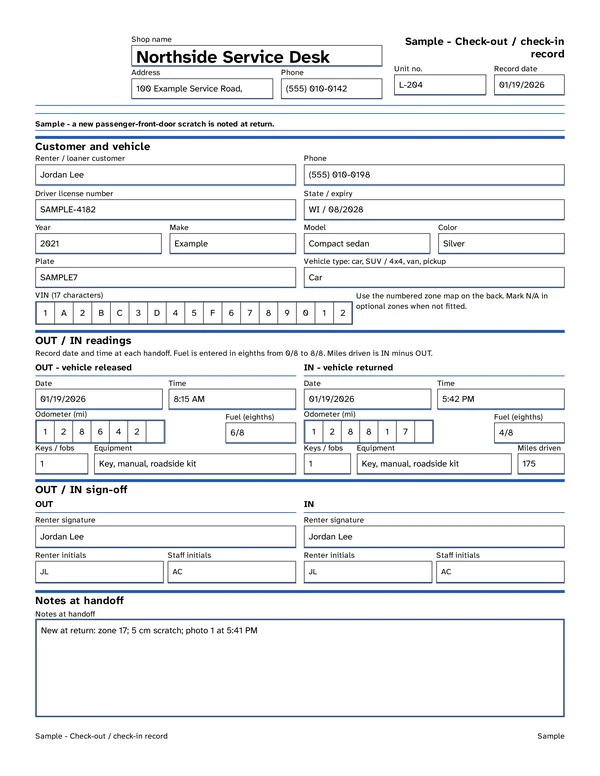 Filled sample, record
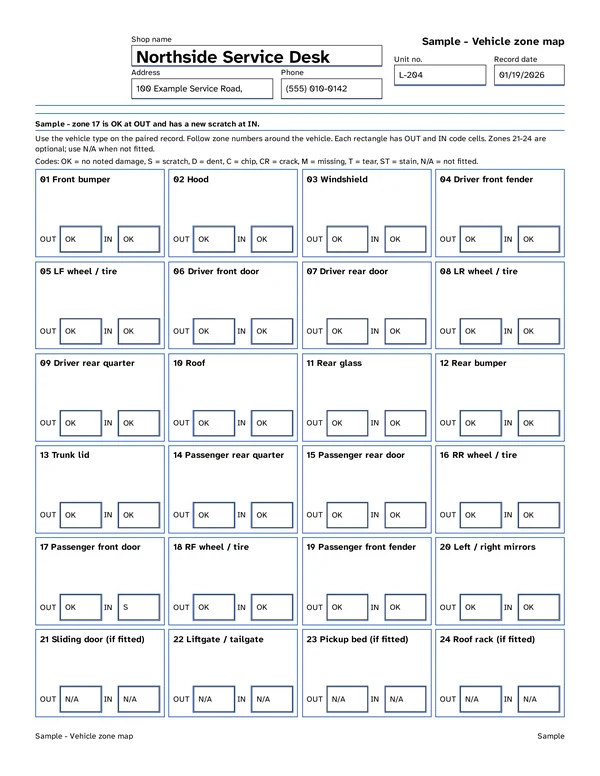 Filled sample, zone map
Two of the kit’s 10 pages, filled in as training samples.
Our rental check-in and check-out form is one record per rental: fill the OUT column before the keys leave and the IN column when they come back, with the condition marked zone by zone.
Pay once at checkout (payment by Stripe Checkout). You land on our thank-you page and the files arrive by email. Nothing is shipped.
Or all three kits for $8.00. Add the multi-point and the condition report kits for $4.00 more.
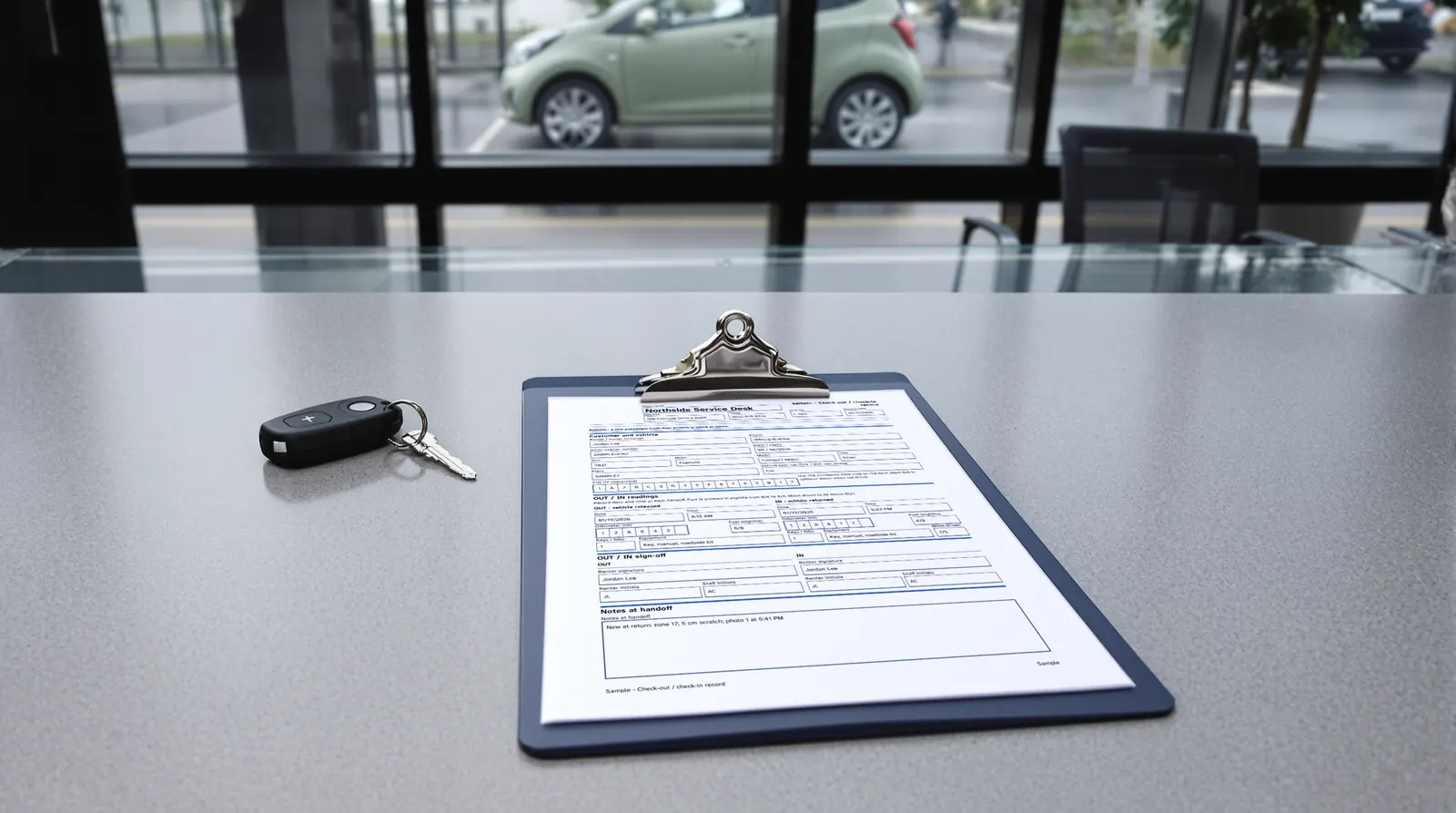
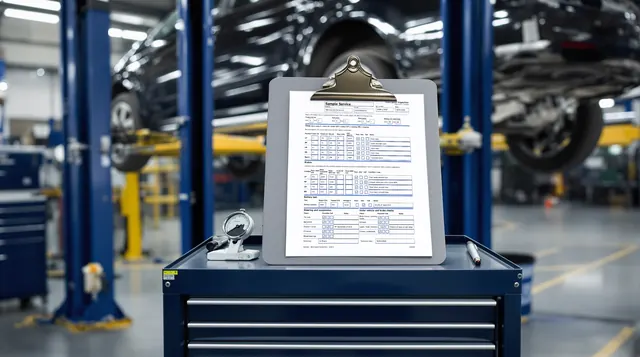
Real sheet: check-out / check-in record, filled training sample. Scene is an illustration.
Yes, the kit includes a counter log with one row per vehicle for the whole counter. Each row holds the out and in times, odometer, fuel, due-back time, miles driven, a damage flag and staff initials. Keep one counter log per counter, so every vehicle that leaves is on one page.
The record and the zone map print as one double-sided sheet. The log pages you print as you need them.
The kit’s title page.
How to set up, print and mark each OUT and IN cell.
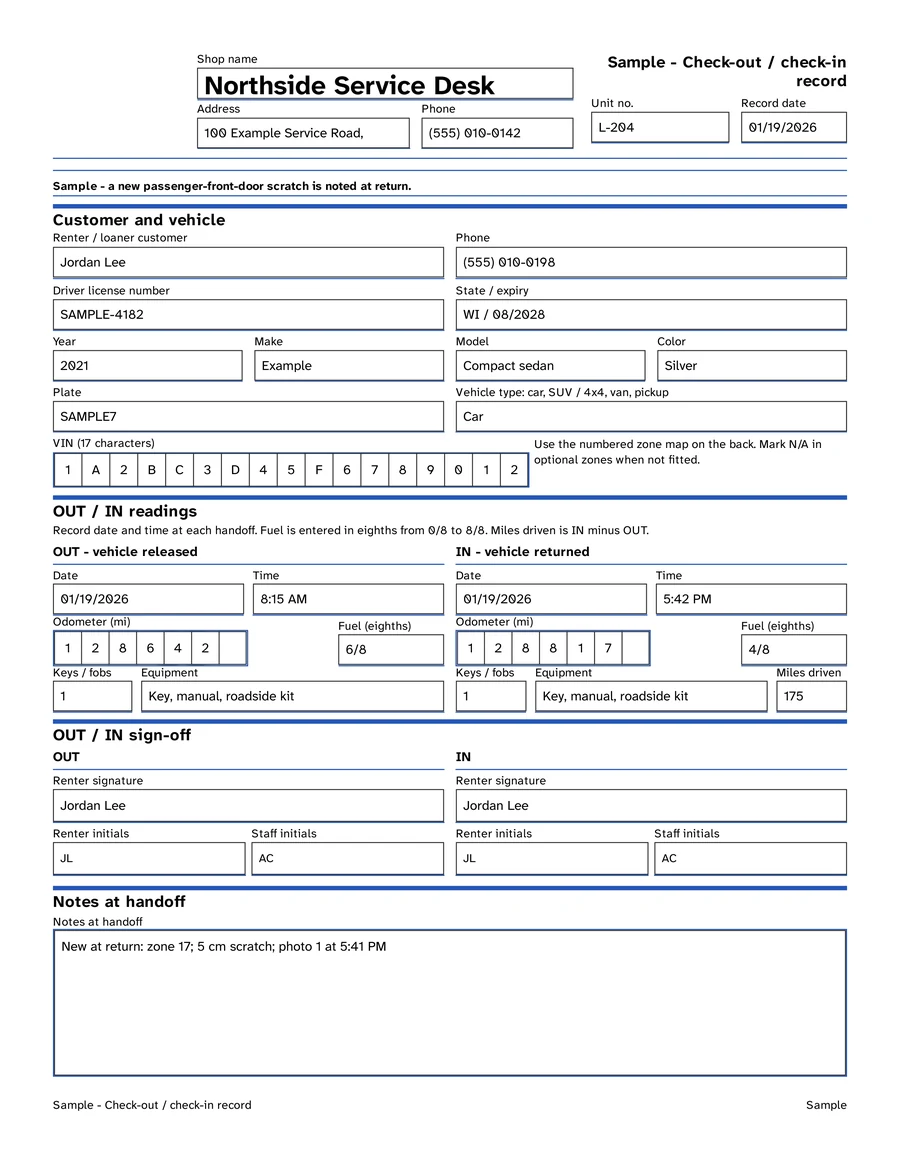
Renter or loaner customer, driver license, vehicle and 17-character VIN. OUT and IN readings side by side: date, time, odometer, fuel in eighths, keys and equipment, miles driven. Sign-off both ways and notes at handoff.
Numbered zones around the vehicle, each with an OUT and an IN cell. Works for cars, SUVs and 4x4s, vans and pickups. Zones a vehicle does not have are marked N/A.
Body, glass, lights, wheels, interior, keys, documents and the roadside kit, each with an OUT and an IN cell: OK, X for an issue, or N/A.
One line per issue: zone or item, OUT or IN, damage detail, size, photo number and time, staff and customer initials.
One row per vehicle for the whole counter: out and in times, odometer, fuel, due back, miles, a damage flag and staff initials.
A worked example for staff training, showing a new scratch noted at return.
The matching back, with the new scratch marked in its zone.
Every item checked OUT and IN, with one issue sent to the damage log.
Yes, the zone map is a numbered grid of zones around the vehicle, each with an OUT cell and an IN cell, for cars, SUVs and 4x4s, vans and pickups. The filled sample shows a rental going out at 8:15 AM and coming back at 5:42 PM with a new scratch on zone 17.
The bay sheet, the counter sheet and the condition report, with your shop’s name on every page. One checkout, one email with all the files.
Before the keys leave, fill the renter, the vehicle and the OUT readings, then walk the car and mark each zone on the zone map. At return, fill the IN readings in the matching column and mark each zone again. Anything new goes on the damage and photo log, one line per issue.
With this kit, the counter walks the vehicle zone by zone and writes a code in each zone’s IN cell: OK for no noted damage, or S scratch, D dent, C chip, CR crack, M missing, T tear, ST stain. The IN cell sits next to the OUT cell, so a difference is easy to see. A difference gets a line on the damage and photo log with the size and photo number.
The filled sample is a rental going out at 8:15 AM and coming back at 5:42 PM with a new scratch on zone 17. The record shows OUT and IN readings side by side, the zone map shows the scratch in its zone, and the vehicle checks page sends the one issue to the damage log. The three sample pages are for staff training.
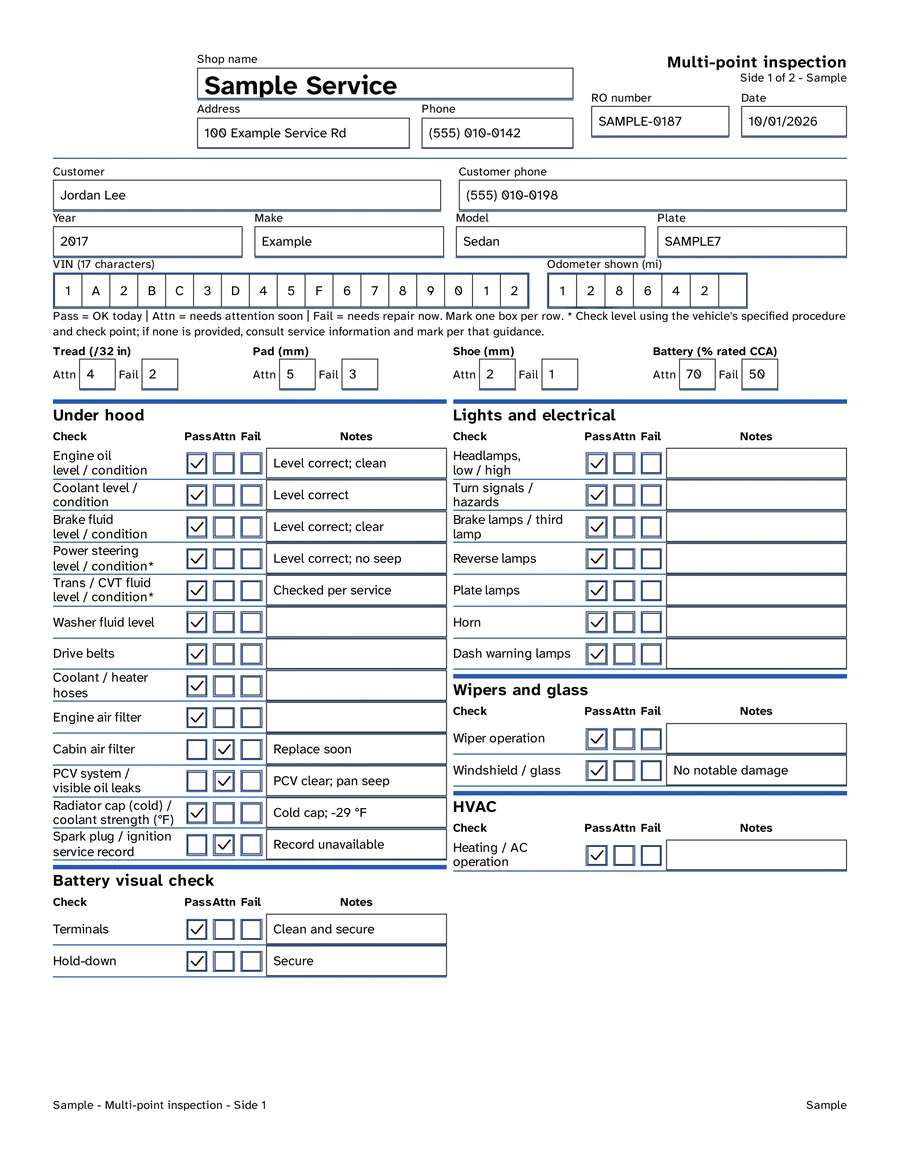
The paid kits hold full sets of fillable inspection sheets, and the free sample is side 1 of the multi-point inspection. For the counter, this kit is the check-out and check-in record with a zone map, a damage and photo log and a counter log. Each kit comes as US Letter and A4 PDFs.
Yes, the record has a field for the renter or loaner customer. It works the same way for a loaner that leaves while the customer’s own car is in the shop.
Fuel is written in eighths, from 0/8 to 8/8, at check-out and at check-in. Miles driven is the IN odometer minus the OUT odometer.
A two-sided multi-point inspection for the bay. A findings and estimate page for the counter. Shop standards you set once.
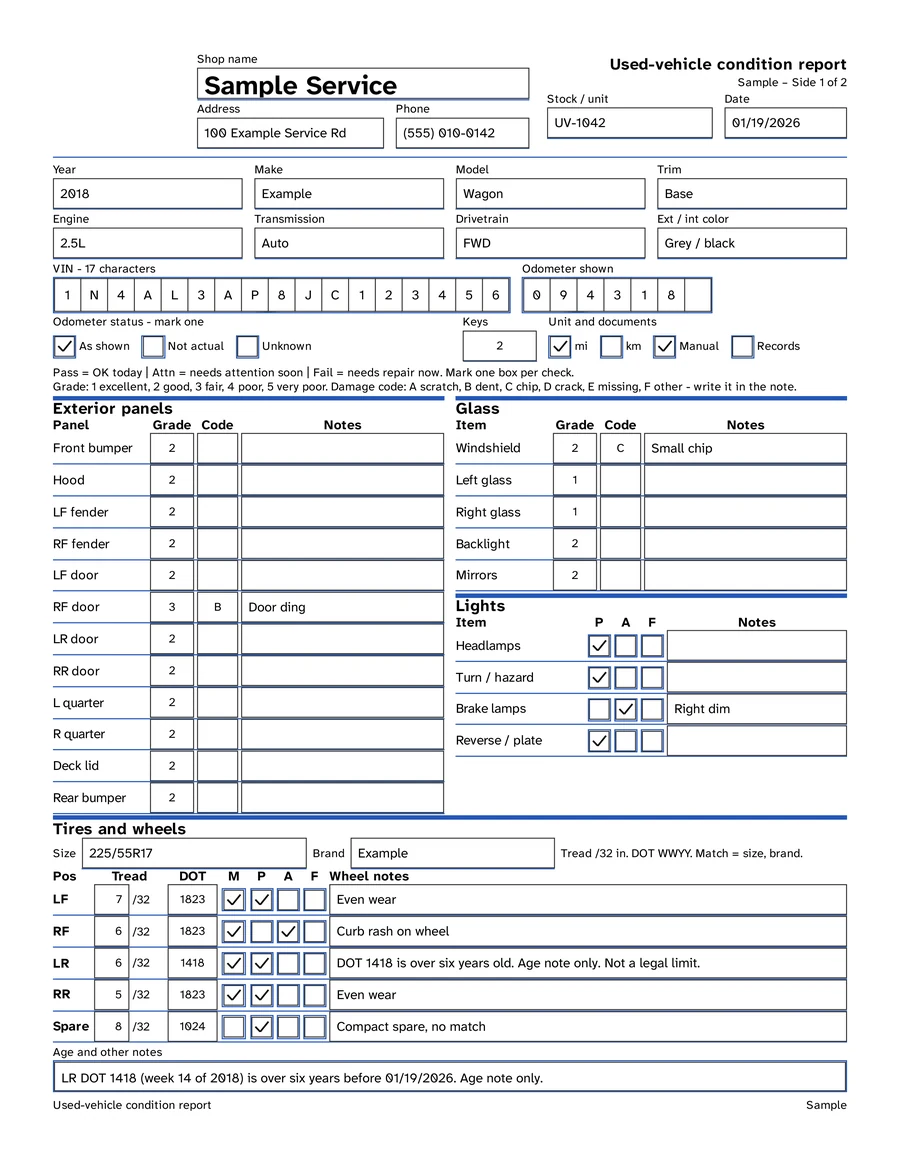
A two-sided condition report with the VIN, from panels and tires to the road test. A reconditioning list comes with it. It records condition, not a price.